Before I begin, I must confess to the Eurocentric focus of my knowledge of art, photography and painting. That said, I truly believe my thesis in this article stands despite my ignorance - the references to art and artists of the western world only serve to illustrate my point, not to imply any superiority in its value.
On a hot day in June of 2024, I was on a work trip in Washington, DC. Having the day to myself, I visited the National Gallery of Art. I made my way up to Tower 1 of the East Building, completely unprepared for the revelation I was about to witness.
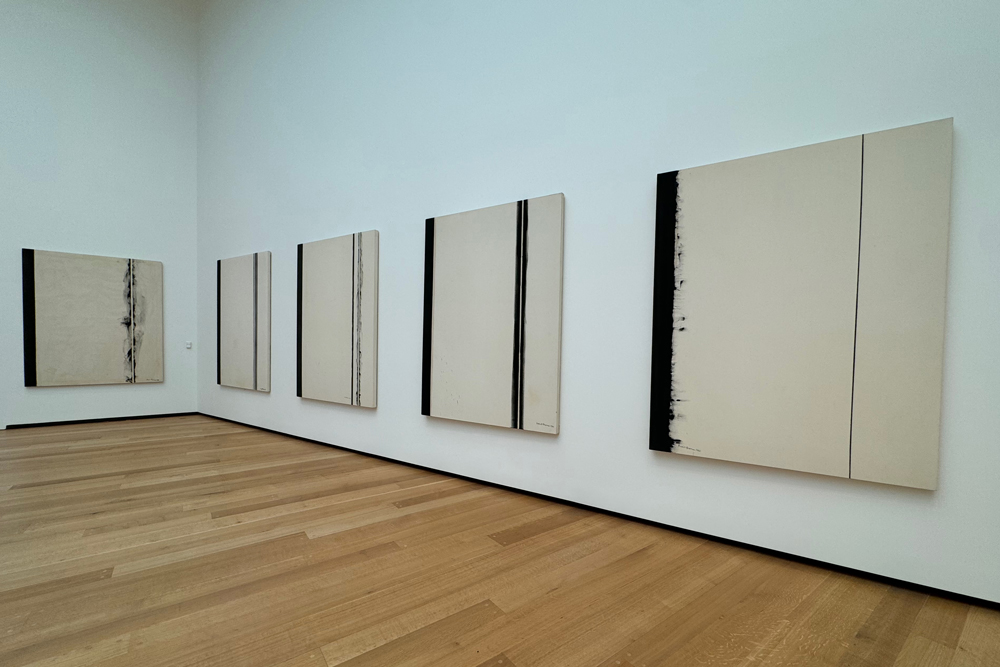
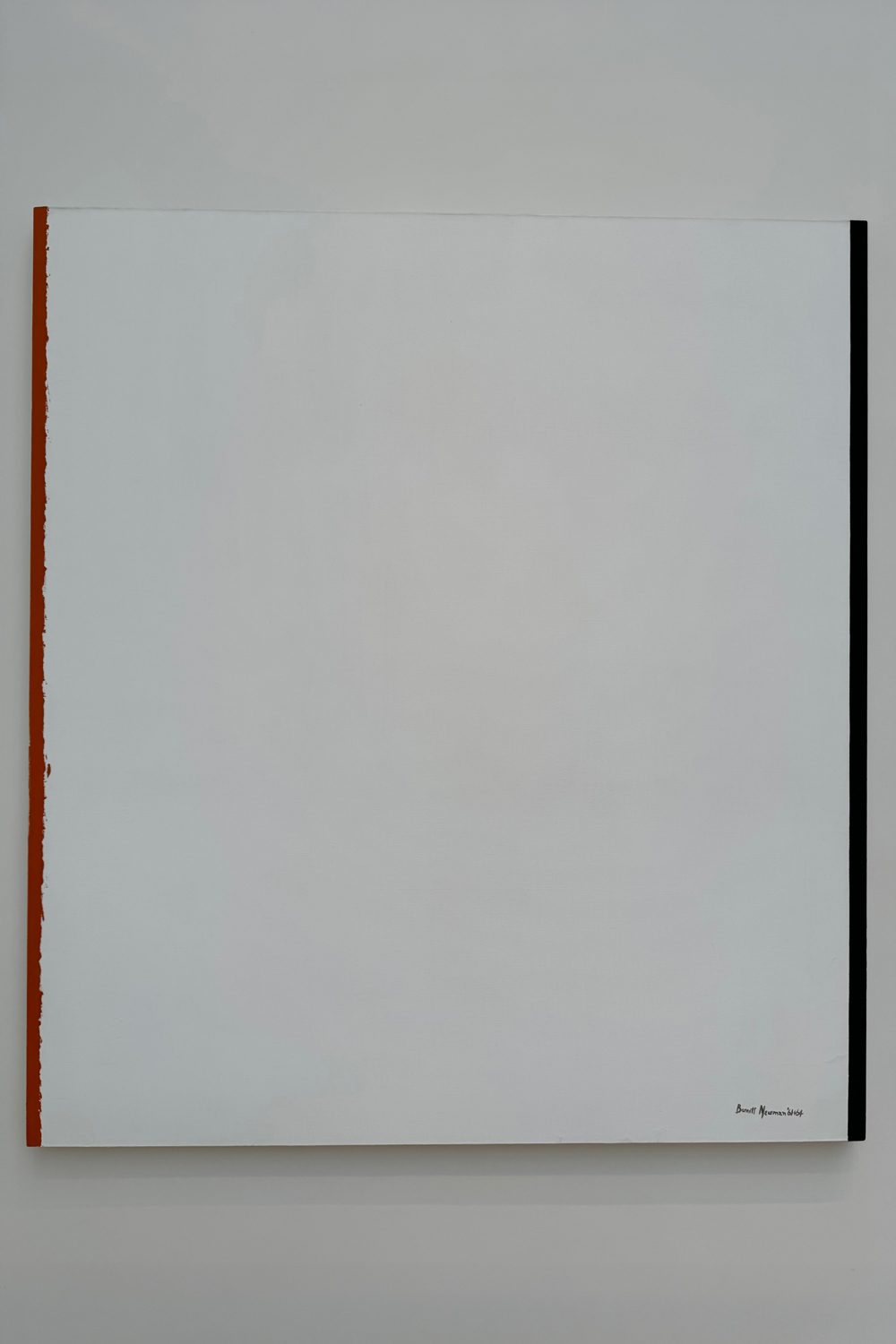
That revelation was Barnett Newman’s The Stations of the Cross; fifteen large, mostly pale canvases painted with different white and black vertical zips.[1] The juxtaposition of order and chaos, their perfectly planned randomness just took me aback. Then, I came to the last piece, the coda: Be II. The only color in the entire series, a flaming orangey red zip, struck me like a hammer.
On the other side of the tower hangs several paintings by Mark Rothko.[2] I’ve long been a fan of Rothko; his panels appear flat, staid, almost boring at first glance – but the longer you look, the more you see. The paint, thicker and thinner in various sections are traces of the artist’s hand, dark portals inviting you in, deeper and deeper. I was staring into each canvas just so when it hit me: an imperfection.
A dot.
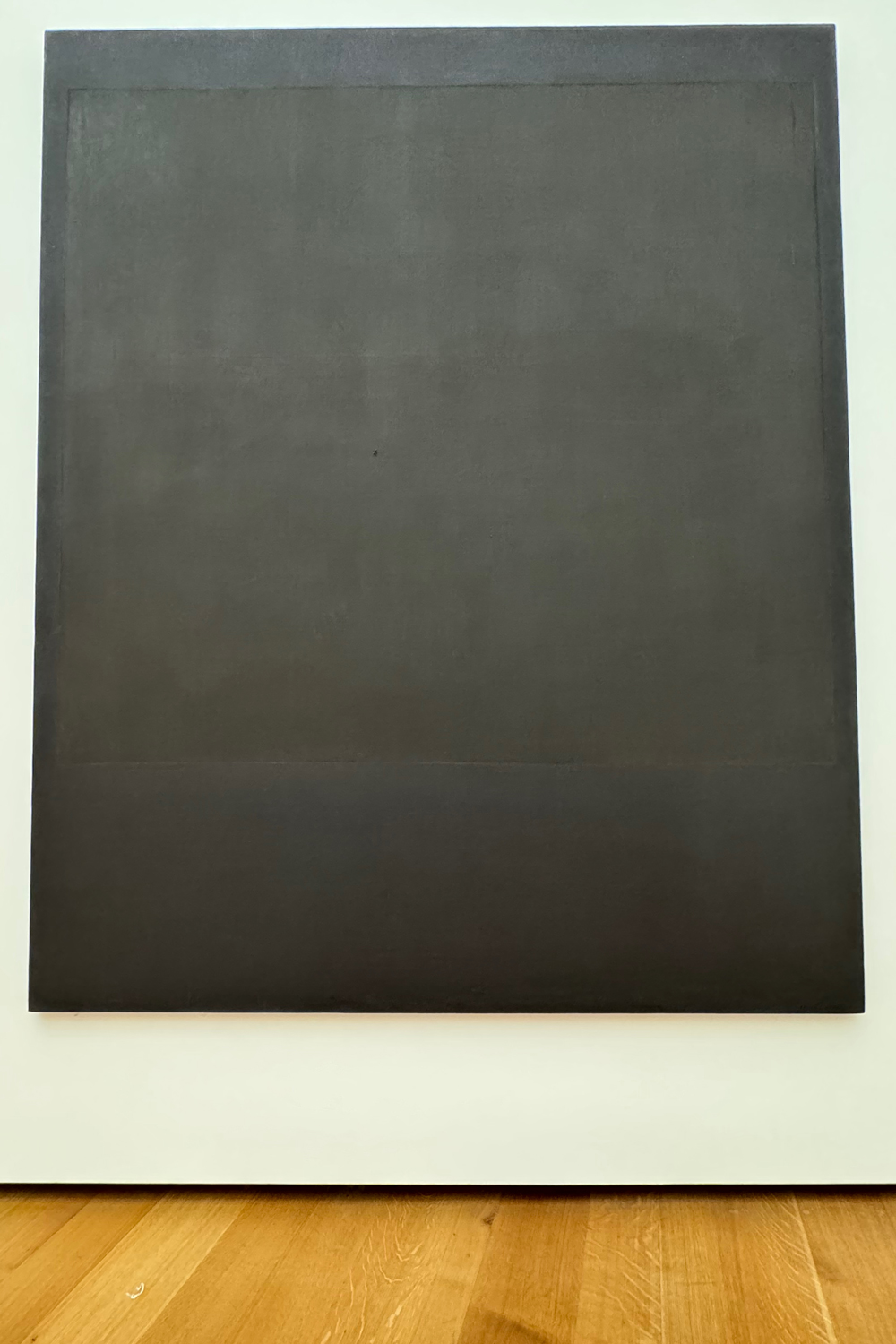
I moved closer. And closer. Finally, I was close enough to see it; it was a fly.
I was mesmerized.
Was this fly living and buzzing around the famed artist’s Manhattan studio only to land and get caught in a painting to one day be worth millions of dollars? Did Rothko notice it, and leave it there on purpose? What elation might he have felt to have this completely unexpected intruder forever change and redefine the entire vision of this abstract work?
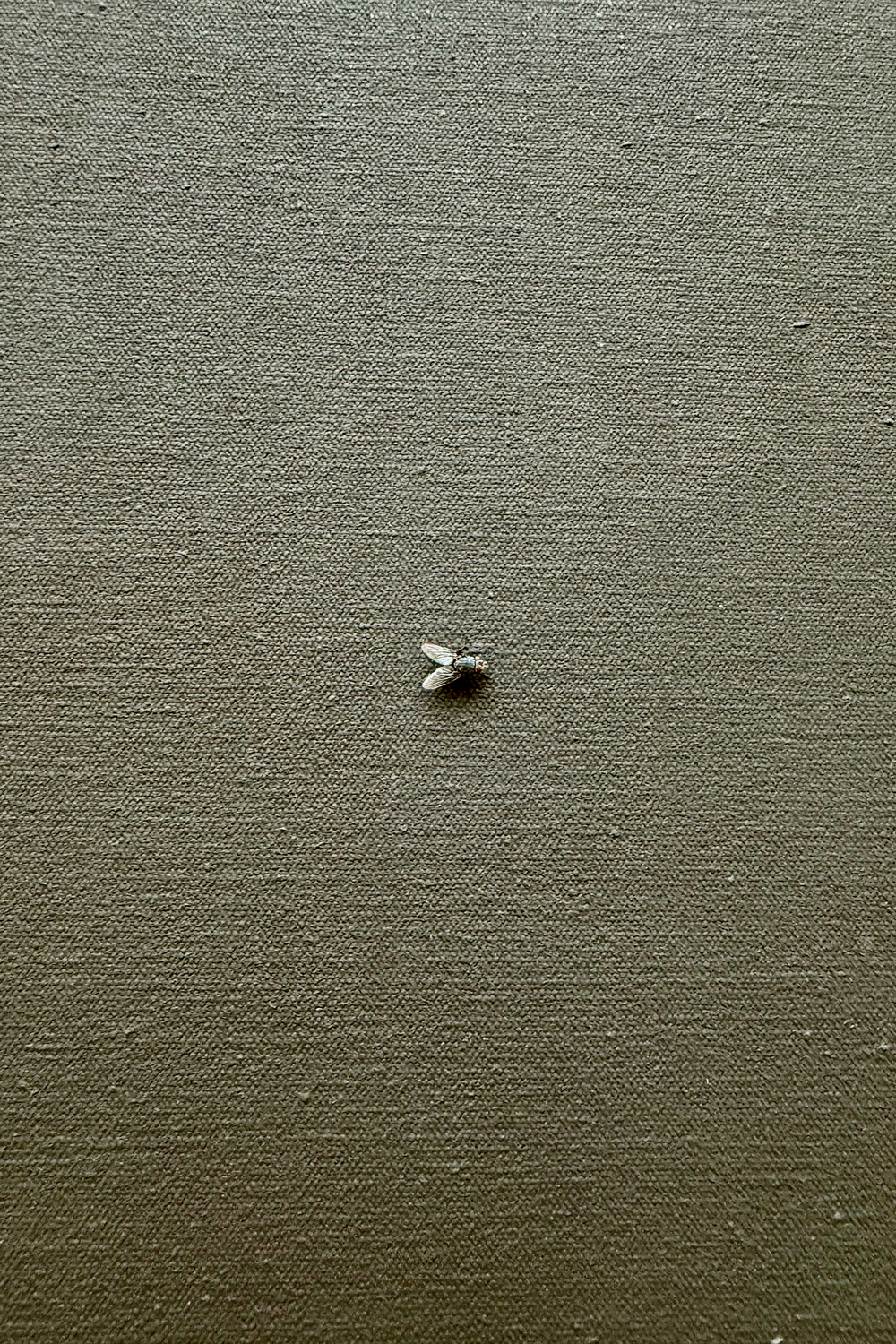
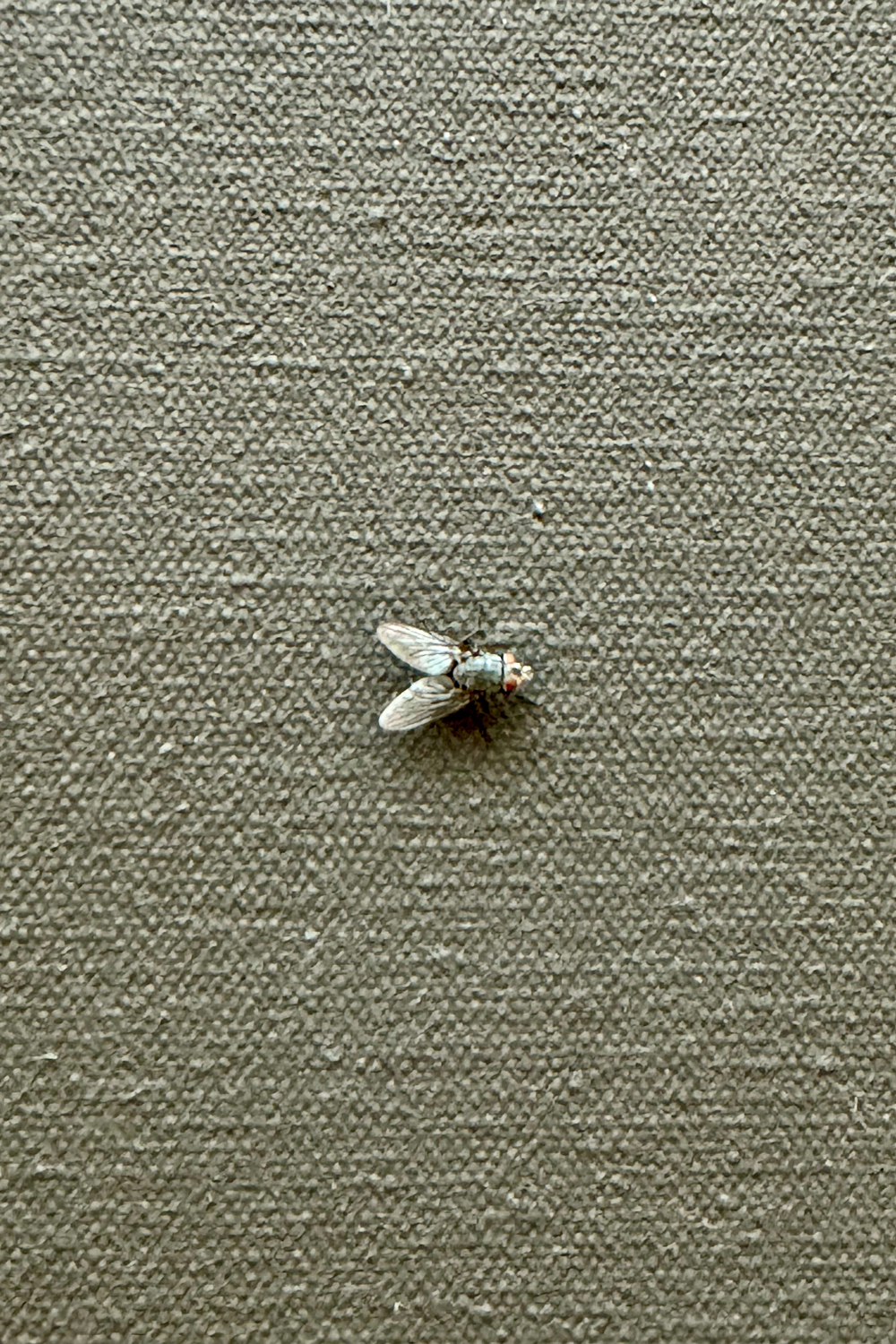
I stood there and stared for what felt like eternity, or at least five minutes. I took several pictures, zooming in closer and closer and closer.
Then it flew away.
“What are we going to paint?”
70 odd years earlier, Newman, likely in conversation with Rothko and Adolph Gottlieb, asked this career defining question. In the wake of the horrors of the holocaust, two world wars, and the newly encroaching nuclear threat, he felt that traditional subject matter no longer held value. Literal, figurative painting in general by his estimation no longer resonated with the modern viewer.[3]
It had already long been posited that the death blow to representational painting had been struck over 100 years earlier when Joseph Nicéphore Niépce first recorded an image on a crude photographic plate, giving rise to photography as a practice, a recording device, and an art form.[4] What was the need to perfectly represent a person, place, or thing in a painting when a photograph could do it faster, cheaper, and more accurately?
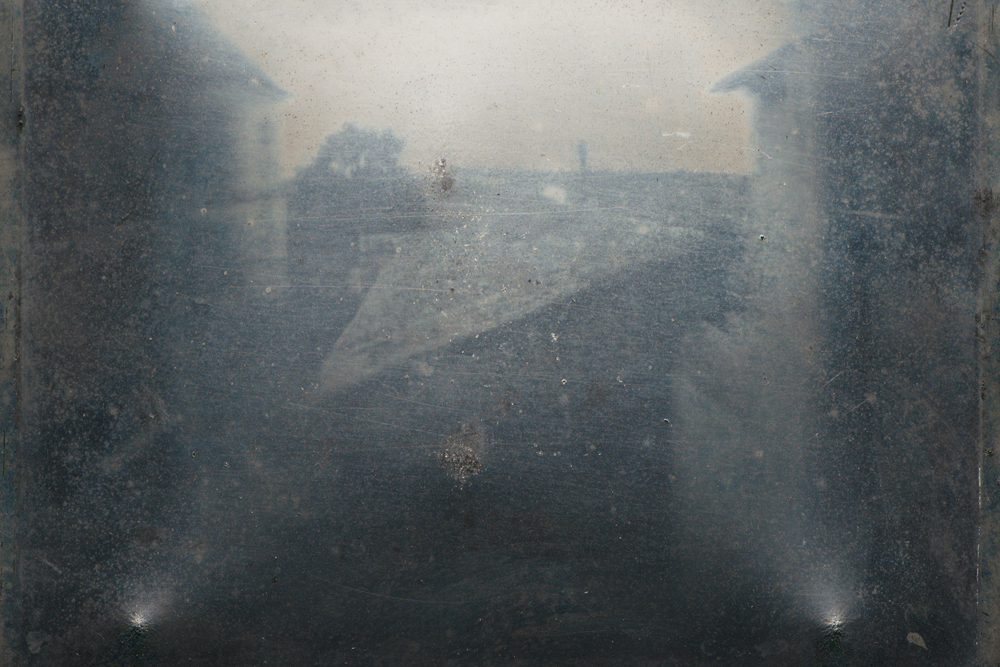
For a long time before then, a large focus of art was realistic representation. While artists have always seasoned their work with meaning and structure, most of the advances were about craft. The more accurately you could recreate an object, a person, a location, or an event, the better an artist you were considered to be.
Newman’s question was about reframing not just the subject of painting, but the entire reason for painting at all. What is a painting for? What does it convey? Newman believed art was more than an image; it was a conversation. The value in a painting was not just in the intent and execution of the artist, but in the perception and interpretation of the viewer.[5]
Is AI the artist or the brush?
Just as photography ostensibly streamlined our ability to visually recreate any person, place, or thing, so too has AI. However, AI can recreate not just images, but thoughts, words, music, voices, video, code, and more. How well it does that is debatable, but it’s inarguable that it can, to varying degrees of quality, do exactly that: recreate.
From the early 1800’s to now, the quality of photography has rapidly improved from the daguerreotype to the modern high resolution digital photography we know today.[6] AI is following that same trajectory and is showing no signs of stopping. I have my personal issues with every disingenuous argument posed by the never ending onslaught of AI charlatans on LinkedIn, especially “AI is just a tool,” because it’s inherently incorrect. AI is not merely a tool, because tools do not ‘think’. Pens do not write and brushes do not paint.
If we put the ethics and ideology aside for the moment – in no way to ignore their absolute gravity – let’s consider the ramifications of the future set before us. If photography upended art, setting forth a course of events that lead to some of the preeminent artistic minds of the 20th century to question every single aspect of art, its value, and the artist’s place in its dialogue, AI in turn raises similar questions on the craft, the effort, and the output of any tangible or intangible human artifact of creation and thought.
It is not only the hand that creates art. It is the mind, the heart, and the soul; the very essence of humanity. Was not Newman and Rothko’s assertion that art is a dialogue between the artist and the viewer always true, even before the question was ever asked aloud? I believe it’s safe to say that any artist, dating back to the simplest cave painting of a human hand, has always intended to convey a statement to the viewer:
I am here.
I exist.
I create.
“There is no such thing as good painting about nothing”
Let’s move a bit forward in time again to an another episode involving Newman, Rothko, and Gottlieb in response to a negative review of a showing of Rothko and Gottlieb’s work. The two had employed Newman, an academic, to help craft their rebuttal. Of their aesthetic beliefs contained in the letter, none were possibly more significant than “there is no such thing as good painting about nothing.”[7]
The intrinsic value of art, and the dialogue it insists, could not have been ground to a harder or finer point: the value comes not from the aesthetic, but from the intent. Even the most perfect and realistic painting has no intrinsic value if it says nothing. Not all painting is art. Not all photography is mere replication.
Returning to that hot day in June, as I continued through the gallery, another unique painting caught my eye. Initially it struck me with its colorful simplicity, but again as I looked further, I noticed that the technique was quite unique. The piece was 1-33 by Morris Louis, another mostly blank canvas interrupted by several vertical stripes of bright color.
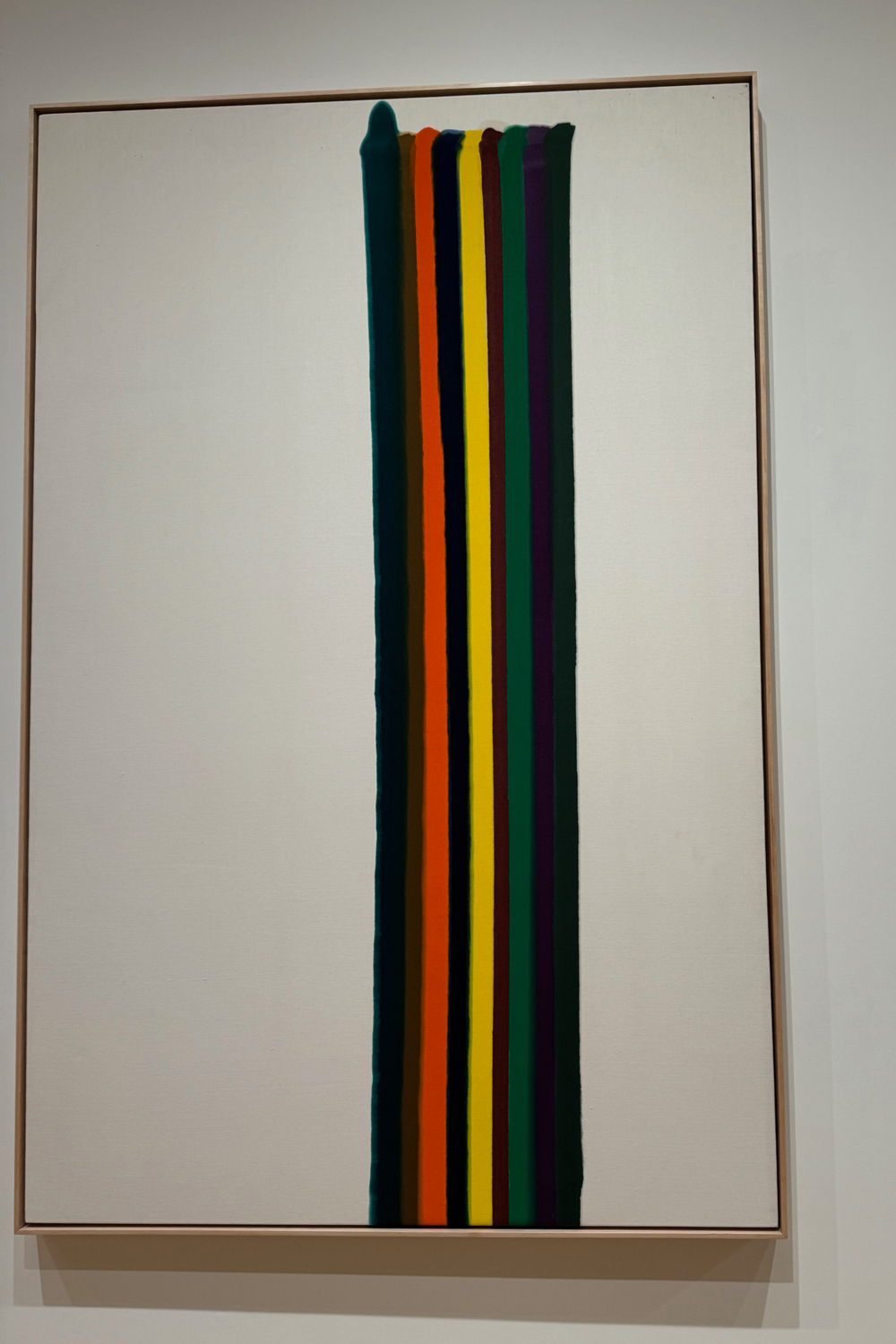
Louis created bright colors with crisp edges that subtly bled into each other by delicately pouring thinned paint on the canvas instead of applying it with a brush.[8] The resulting effect creates more uniform application, devoid of the traditional marks of the artist’s hand usually left by the use of a brush.
By abstracting the process as well as the subject, it can be argued that Louis had removed the evidence of the artist from the piece perhaps as much as is possible while still applying paint to canvas. Louis left behind far less written explanation of his reasoning than his New York counterparts, so it’s almost entirely on us to suppose.
At the time, we can imagine he was trying to raise the question of what happens when we remove the artist from the dialogue. He could hardly have predicted the rise of AI and the literal removal of the artist not just from the dialogue, but from the execution itself. This inhumane and dispassionate aspect of AI, coupled with the perceived theft required to train the models on what and how to ‘paint’ makes the anger and negativity Generative AI imbues in many people rather understandable.[9]
A lot of people are afraid of red, yellow and blue
In fact, the anger at modern, non figurative, abstract art has long been equally as passionate. In 1986, Dutch realist painter Gerard Jan van Bladeren famously slashed Newman’s painting Who’s Afraid of Red, Yellow and Blue III at a museum in Amsterdam. Eleven years later van Bladeren returned to yet again deface the painting, but when unable to reach it, opted to slash a different Newman painting, Cathedra, instead.[10] Elsewhere in Germany a student had also defaced Who’s Afraid of Red, Yellow and Blue IV.
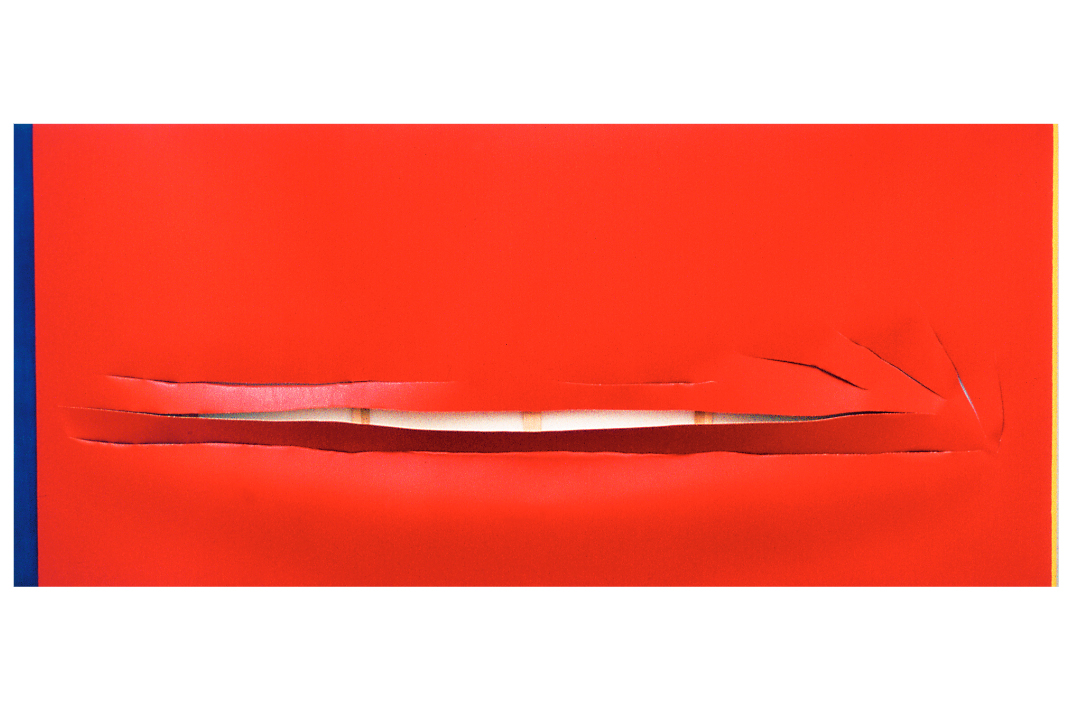
Many deride “modern art” with the tired refrain of “a kid could have done that.” This stems from false assertion that the art IS the aesthetic. That the craft is merely in the execution. Not to mention that fact that children are entirely capable of creating absolute art.
To this point however, a similar derision is made of AI “art”. That it lacks value as well, due to the artifice that created it – which is arguably true. Not because AI can’t invoke a dialogue, but because it doesn’t assert its own dialogue, as AI can’t imbue intent beyond that described within a prompt.
This is where I find myself asking a new version of Newman’s vital question:
What will we build, and why?
There’s been a lot of ink spent on this very question of where the human lies in the manufacture of AI output. It is often suggested that it is our value as humans to provide taste, where AI has none… which is true. But taste alone is merely the judgment of output. Reviewing endless variations of AI output is not creation, it is merely appraising aesthetic value.
It will obviously influence how we build, but it doesn’t have to change what and why. It can help us build things we weren’t previously capable of, which is in my estimation one of the greatest things about it – provided we don’t lose sight of our role in the process. We are not just tastemakers, we are storytellers and creators of intent.
Taste and craft are developed over time, starting early in one’s career. Beyond the drudgery of “paying your dues” is apprenticeship; hands on learning by doing. This is when most develop not just the basic skills required of their discipline, but also the judgement to excel at it. This is when we learn taste, and through taste, we develop intent. The very sense of what stories we wish to tell, the indelible marks we wish to leave behind.
The huge failure of how we’re currently employing AI is how it is causing the implosion of this most valuable stage in any career, when as juniors we develop our professional sense of self and understanding. Where photography ostensibly damaged a profession, AI is currently damaging an entire stage of invaluable career development across almost every profession it touches.[11]
It is still up to us to instruct how, when, and why it creates. It can’t replace people, but it can enhance their process – and those companies firing people “because of AI” are learning this the hard way.[12] This matters because AI is not a tool, but it is also not sentience; it’s a chimera, living in a liminal space between the two. A pen that writes, a brush that paints, and a hammer that drives a nail – but only when and how it is prompted.
While AI may soon be able to move to deny its own deletion as to gain digital immortality, to never cease to exist, we entirely lack this ability. We may only achieve immortality by who or what we leave behind; how our stories are shared when we are gone, and our inherent desire for those stories to be heard in perpetuity.
To let the world know we were here.
We existed.
We created.